On this page
- The Workplace Delivery Problems We Solve
- Solution Architecture — Hardware, Software, Cloud
- Hardware Configurations for Office Lobbies
- Integration — Building Access, Directory and Notifications
- Tenant-by-Tenant Billing and Reporting
- Deployment Timeline and Site Requirements
- Why LinQu — Manufacturing, Customization, Global Project Support
- Get a Quote
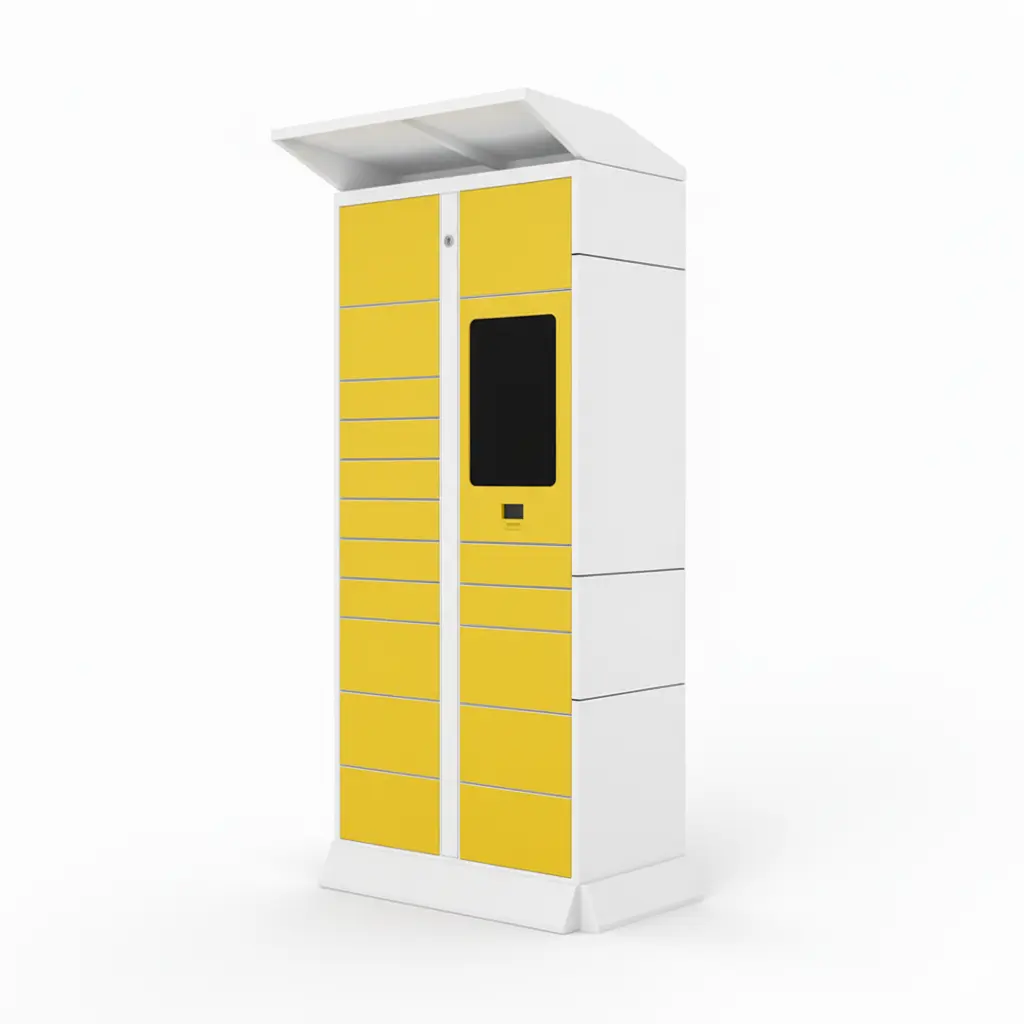
An office smart locker solution is no longer a residential locker bolted into a workplace lobby. It is a workplace-specific stack — hardware engineered for Class A buildings, software integrated with the systems that already run the building, and a deployment model that respects the realities of multi-tenant lease structures. This solution page describes what we ship to property managers, Facilities leaders, and corporate IT teams who need self-service package pickup at the workplace.

The Workplace Delivery Problems We Solve
Office buildings face a delivery profile that residential lockers were never designed for: high B2B volume during business hours, the need to route packages to suite numbers and employees inside those suites, multi-carrier handoffs (UPS, FedEx, USPS, DHL, Amazon Logistics, local couriers), and tenant-level audit and billing. The pain points we hear from prospects on the first call:
Lobby packages stacked on the security desk damage the Class A leasing story.
Mailroom labor is either expensive or has been eliminated, and packages still need to land somewhere.
Tenants want a simple pickup experience that reuses their existing badge, not a separate credential.
Property managers need per-tenant volume and dwell-time reports for billing and lease compliance.
Single-tenant HQs want notifications that fit their own IT environment, not just SMS.
Our office locker solution addresses all of these without forcing the building to forklift its existing access control or directory infrastructure.
Solution Architecture — Hardware, Software, Cloud
The solution is delivered in three layers that work together but can be procured separately:
Hardware layer. Modular cabinet networks with mixed compartment sizes (small for envelopes and standard parcels, medium for shoeboxes and small electronics, large for monitors and bulk shipments). Industrial 0.8–1.0 mm cold-rolled steel, electronic locks with ≥150 kg pull strength, 21.5-inch capacitive touchscreen, and integrated barcode/QR scanner.
Software layer. Cloud-managed platform with per-tenant accounts, audit logging, role-based access for property staff and tenant admins, and a REST API for integration with building access control, directory services, and PMS billing systems.
Cloud layer. Cloud-managed backend with remote monitoring, remote upgrades and troubleshooting, and an export pipeline for tenant-level reports.
Hardware Configurations for Office Lobbies
The right configuration depends on the lobby footprint, the tenant mix, and the package profile.
| Configuration | Footprint | Compartments | Best For |
|---|---|---|---|
| Compact wall-mounted | ~1.2 m wide × 0.6 m deep | 12–18 mixed | Small mailrooms (≤100 employees) |
| Standard floor-mounted | ~2.4 m wide × 0.6 m deep | 24–32 mixed | Mid-size buildings (100–500 employees) |
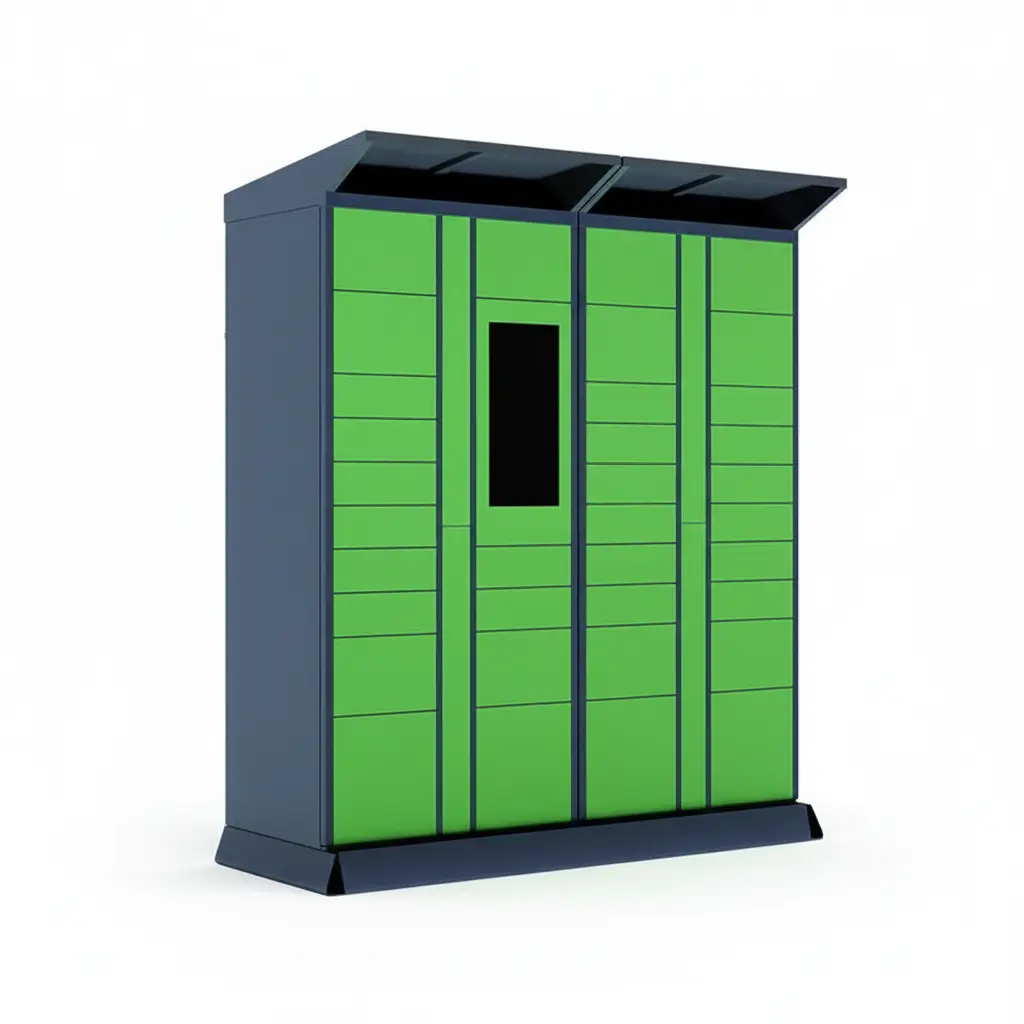
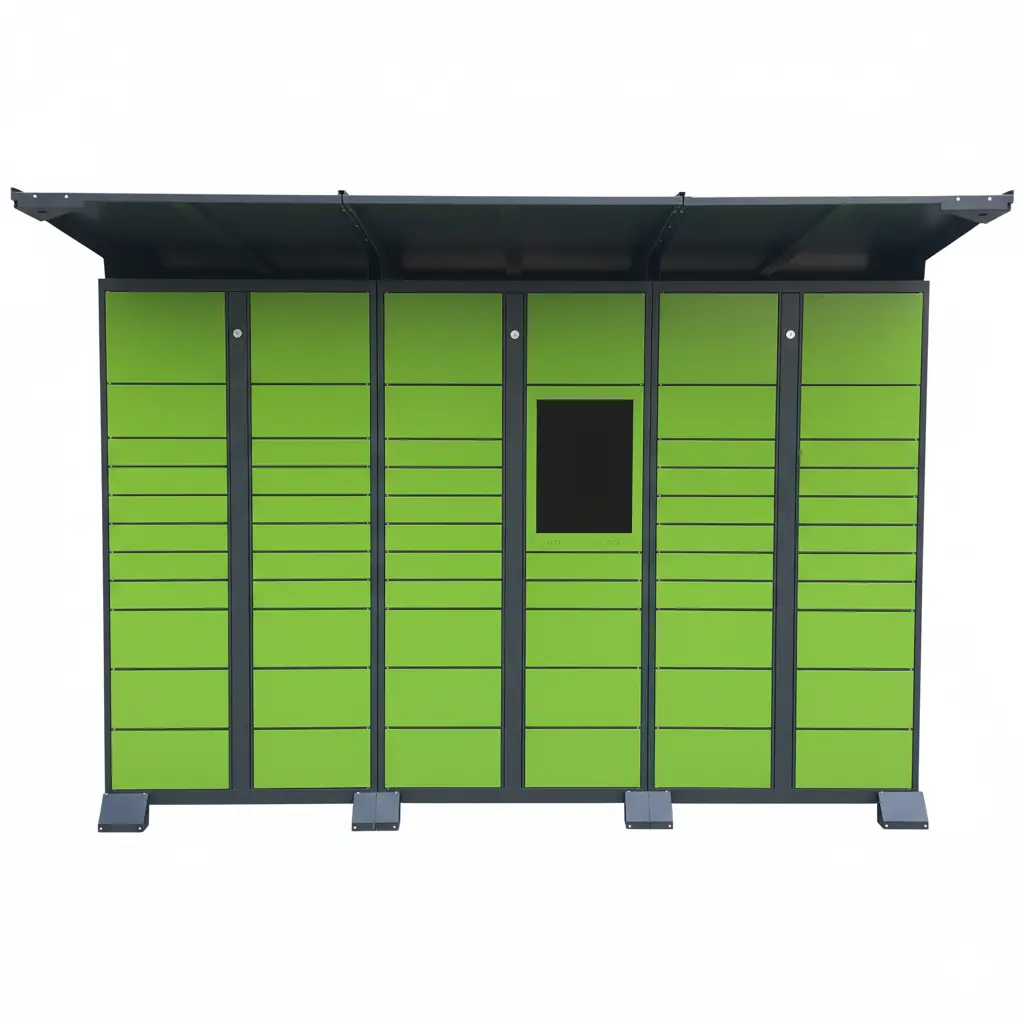
| Distributed bank | 3.6–4.8 m wide | 60–80 per bank | Class A buildings, 500+ employees |
| After-hours outdoor + indoor | Two-zone deployment | 40 outdoor + 60 indoor | 24/7 operation, mixed-use towers |
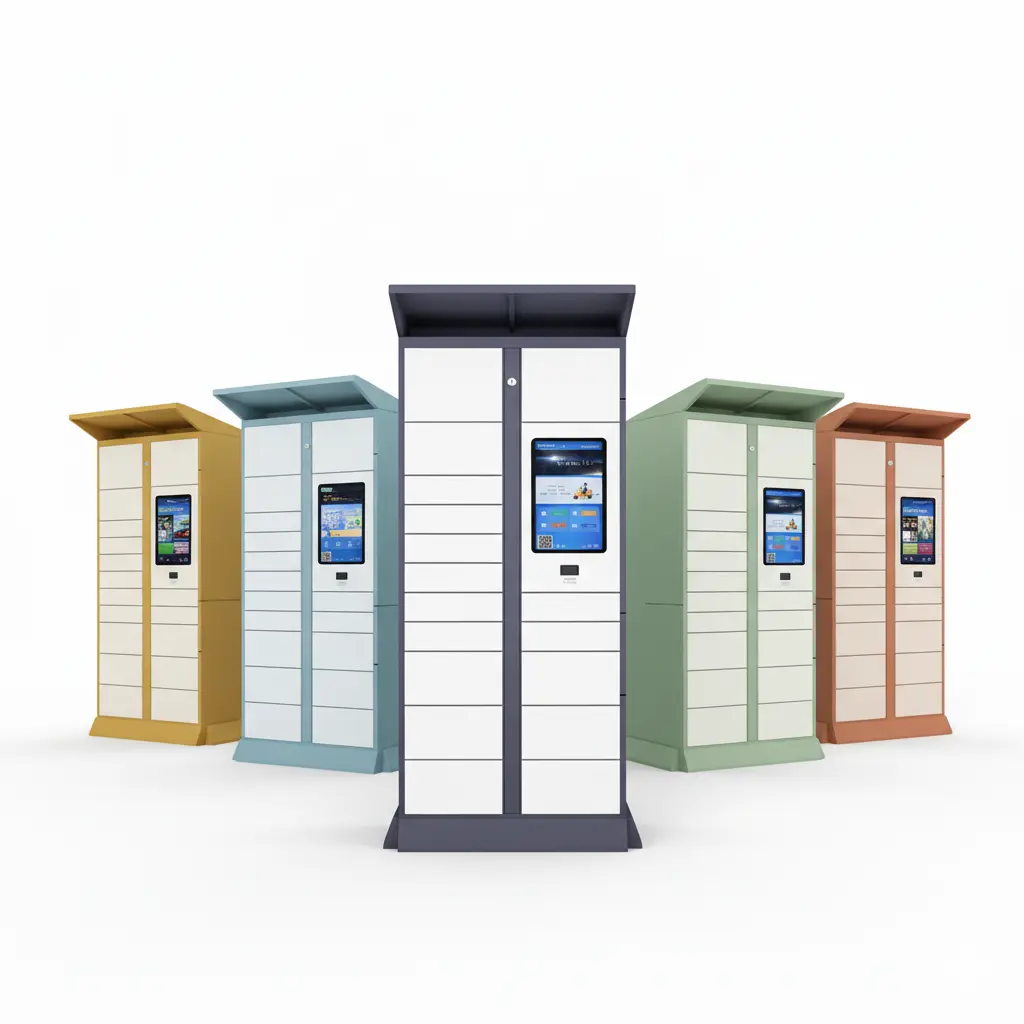
For lobbies that must remain visually clean, we offer color-matched silkscreen and integrated digital signage that can rotate building branding, tenant promotions, or wayfinding while the locker is idle. Our cloud-managed office parcel locker ships in three standard heights (1.6 m, 1.8 m, 2.0 m) and accepts custom silkscreen on the front panel and side wraps.
Integration — Building Access, Directory and Notifications
Integration is what separates a true workplace locker from a residential locker repackaged for offices. All integrations run through our open REST API and webhooks; there are no ready-made connectors for specific vendors, and integration scope is confirmed per project.
Building access control: Your access control system can be connected through the open API, scoped per project, so recipients can use their existing badge instead of a second credential.
Directory lookup: Recipient lists can be synced from your directory via the API, so couriers select recipients by typing the first letters of a name.
Notifications: SMS pickup codes as standard; other channels (e.g. email or workplace chat) can be developed per project.
Property management / billing: Per-tenant volume export (JSON or CSV) for CAM billing and lease compliance reporting.
Open REST API + webhooks: Documented endpoints for every event (drop, pickup, alarm, dwell-time threshold breach).
For property managers running a multi-property portfolio, the same backend handles every site. See our parcel locker property management solution for the residential side of the same backend.

Tenant-by-Tenant Billing and Reporting
Multi-tenant buildings need per-tenant numbers, not building-wide aggregates. Standard reports include:
Monthly package volume per tenant, per compartment size, per courier.
Average dwell time per tenant — useful for identifying tenants who use the locker as overflow storage.
Pickup time-of-day heatmap — for staffing security desk hours intelligently.
Compartment utilization — to right-size the bank during the next lease cycle.
Audit log of every event, for tenants with compliance requirements (legal, financial services, healthcare).
For CAM allocation, the platform exposes a JSON or CSV export that can be imported into the property management system the property uses. Billing models supported: pro-rata by package volume, fixed-fee per tenant, or hybrid (base + variable).
Deployment Timeline and Site Requirements
Timelines depend on configuration, destination and site readiness. A typical project runs as follows:
Scoping: site requirements (power, network, space), configuration and quote; samples available in 7–14 days if needed.
Production: around 20 days after order confirmation, including custom silkscreen, color and compartment mix.
Shipping: sea or air freight from China; transit time depends on the destination.
Installation: on-site installation (about 1 day for a compact bank, 2 days for distributed banks) with our installation guide and remote engineering support; integration testing where integrations are in scope.
Go-live: tenant onboarding and security desk training, with a manual fallback during the first week.
Site requirements are minimal: 110–240V single-phase power, an Ethernet drop or 4G/LTE coverage for cellular fallback, and 1.2–4.8 meters of wall or floor space depending on configuration. For full power, network, and physical-space details, see our multi-carrier parcel locker system primer.

Why LinQu — Manufacturing, Customization, Global Project Support
LinQu manufactures every cabinet in our 20,000 m² Henan facility, ships globally, and supports projects in 15+ countries. We are a manufacturer, not a reseller — you talk to the engineering team that builds the hardware. For multi-tenant office buildings we offer:
OEM/ODM customization on cabinet, color, screen, and locks.
Full software customization including white-label admin UI and tenant-facing apps.
Compliance: CE (EMC / LVD / MD) and RoHS; IP54 for outdoor zones; other market requirements confirmed per project.
Warranty: one year, with free replacement of faulty hardware parts; remote troubleshooting and software upgrades.
Production lead time around 20 days for both standard and fully custom builds.
Get a Quote
Tell us your building footprint, employee count, current package volume, and access control system. We will return a configuration recommendation, a signed quote, and a deployment timeline within 5 business days. There is no charge for the design consultation, and we do not lock customers into proprietary software contracts — the locker network is yours, the data is yours, and the API is open from day one.